
How to Choose a Duet Insert: Simple Guide
You crawl into bed, pull up the covers, and immediately notice something feels off. The duvet is flat, too hot, or full of annoying lumps. The problem is almost never the cover. It is the insert doing the heavy lifting, and most shoppers choose one without understanding what actually makes a duvet comfortable. Fill type, fill power, fill weight, construction, and shell material all shape how you sleep, yet product descriptions rarely explain how these pieces fit together.
This guide breaks down each factor using real performance data and material science, so you can match an insert to your sleep style, climate, and budget. You will learn what separates goose down from down alternatives, why fill power and fill weight are not the same thing, and how to avoid the most common buying mistakes.
Match the Insert to Your Sleep Temperature

Your body temperature at night is the single biggest factor in choosing a duvet insert. The wrong warmth level causes restless sleep, night sweats, or constant shivering. Start by identifying your sleeper profile, then match it to the right fill weight and material.
Hot Sleepers: Lightweight and Breathable Fills
If you wake up sweaty or kick off the covers by 3 a.m., you need a breathable, low-weight insert. Summer weight duvets with low fill weight work best, especially when paired with temperature-regulating materials.
- Best fills: High fill-power down (700+), TENCEL™, bamboo, or silk
- Why it works: These materials wick moisture and allow air to circulate. High fill-power down traps heat efficiently but uses less material, reducing weight and heat retention.
- Avoid: Heavy synthetics or winter-weight fills that trap heat and restrict airflow.
- Pro tip: Pair your insert with a cotton or linen duvet cover for maximum breathability.
Cold Sleepers: Maximum Warmth Without Crushing Weight
If you always reach for extra blankets, prioritize insulation and fill weight. You want warmth that wraps around you without feeling like a weighted blanket pressing down.
- Best fills: 700–800+ fill-power goose down, wool, or extra-warm down alternatives
- Why it works: Large down clusters create more air pockets, providing superior warmth with minimal weight. Wool naturally retains heat even when damp.
- Fill weight matters: Choose Extra Warm or Winter classifications. High fill power combined with high fill weight delivers maximum coziness.
- Bonus: Baffle box construction prevents cold spots by keeping fill evenly distributed throughout the night.
Couples with Different Needs: Try the Scandinavian Sleep System
One partner freezes while the other sweats. The solution is not compromise but separation. Use two twin-sized duvets on a queen or king bed.
- Each partner selects their ideal warmth level independently.
- Eliminates the nightly duvet tug-of-war.
- Use matching covers for a seamless, intentional look.
Choose the Right Fill Material

The fill determines how your duvet feels, performs, and lasts. Natural and synthetic fills each have distinct strengths, and your choice depends on allergies, ethics, budget, and care preferences.
Goose Down: The Luxury Standard
Goose down remains the gold standard for a reason: an unmatched warmth-to-weight ratio and a lifespan measured in decades.
- Larger clusters than duck down create higher loft, better insulation, and longer durability.
- Fill power of 700 or higher delivers luxury, lightweight warmth.
- With proper care, a quality goose down insert lasts 10–20 years.
- Ideal for cold sleepers, luxury seekers, and anyone chasing a cloud-like feel.
Check for RDS (Responsible Down Standard) or IDFL certification to ensure ethical sourcing with no live-plucking or force-feeding.
Duck Down: Budget-Friendly Warmth
Duck down offers solid performance at a lower price point, but with clear trade-offs.
- Smaller clusters produce lower fill power, typically 500–600.
- Heavier than goose down for the same warmth level.
- May retain a slight odor if not triple-washed during manufacturing.
- Best for warm climates, summer use, and budget-conscious buyers.
Look for triple-washed down to ensure hypoallergenic properties and odor-free performance.
Down Alternatives: Hypoallergenic and Easy to Maintain
Made from polyester, microfiber, or advanced gel fibers, down alternatives suit allergy sufferers, vegans, and anyone who wants machine-washable convenience.
- Fully hypoallergenic with no animal proteins and natural resistance to dust mites.
- Machine washable and quick-drying at home.
- Lower upfront cost than natural down.
- Ideal for allergy sufferers, kids’ rooms, and humid climates.
The trade-offs: heavier feel, less breathability, and a shorter lifespan of 3–5 years before loft declines. Premium options like PrimaLoft® and proprietary blends such as Luxurelle™ are engineered to closely mimic natural down’s fluffiness.
Wool, Silk, and TENCEL™: Niche Natural Alternatives
For eco-conscious buyers or temperature-sensitive sleepers, these specialty fills offer unique benefits worth considering.
- Wool: Naturally regulates temperature, wicks moisture, and resists fire. Heavier feel makes it ideal for cold climates.
- Silk: Lightweight, hypoallergenic, and excellent for hot sleepers. Expensive and delicate, often requiring hand washing.
- TENCEL™ and bamboo: Sustainable, silky-smooth, and excellent at moisture-wicking. Perfect for hot sleepers and eco-focused buyers.
A TENCEL™ shell paired with down or down alternative fill creates a cool-to-the-touch, breathable, and durable combination.
Understand Fill Power vs. Fill Weight

Most shoppers confuse fill power with warmth, and that confusion leads to overpaying or under-insulating. Fill power measures quality. Fill weight measures warmth. Knowing the difference transforms how you shop.
Fill Power: A Measure of Loft, Not Heat
Fill power measures how much space one ounce of down occupies in cubic inches. Higher numbers indicate better quality and larger clusters.
| Fill Power | Quality Level | Best Use Case |
|---|---|---|
| 400–500 | Budget | Summer, hot sleepers |
| 600–700 | Good | All-season, moderate climates |
| 700–800 | Premium | Cold sleepers, winter |
| 800+ | Luxury | Extreme cold, maximum fluff |
A higher fill power produces a lighter, fluffier duvet for the same warmth level.
Fill Weight: The True Warmth Indicator
Fill weight is the actual amount of fill, measured in ounces, packed inside the duvet. More fill equals more warmth.
- A 600 fill-power duvet with high fill weight can be warmer than a 700 fill-power duvet with low fill weight.
- Cold sleepers should prioritize high fill weight above all else.
- Hot sleepers should choose low fill weight, even when selecting high fill power.
For year-round versatility in moderate climates, choose medium fill weight with 600–700 fill power.
Choose the Right Construction Method
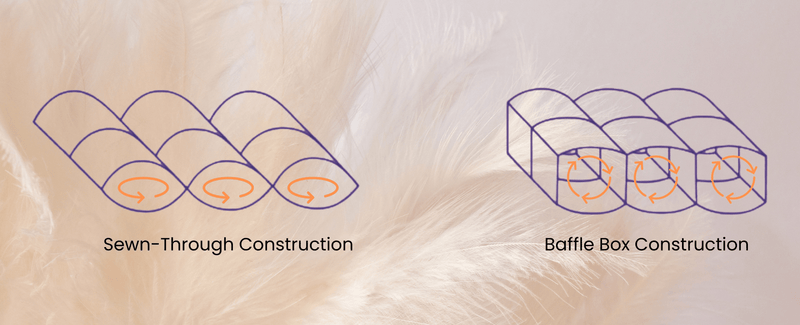
How a duvet is built determines whether the fill stays put, the loft stays high, and cold spots are avoided throughout the night.
Baffle Box: Maximum Loft and No Cold Spots
Vertical fabric walls create three-dimensional boxes that allow fill to expand fully.
- Fill stays evenly distributed with no shifting.
- Maximum loft makes this the standard for luxury hotels.
- No cold spots, unlike stitch-through designs.
- Ideal for down inserts, cold climates, and anyone seeking a luxury feel.
Stitch-Through: Lightweight and Breathable
Top and bottom fabric layers are stitched directly together in a square pattern.
- Produces a flatter profile suited for summer or minimalist aesthetics.
- Can create cold spots along stitch lines where no fill exists.
- Less loft than baffle box construction.
- Ideal for summer weight, down alternatives, and budget-friendly options.
Channel Construction: Balanced Performance
Long vertical or horizontal tubes keep fill in place across the duvet.
- Less expensive than baffle box construction.
- Works well for heavy fills like wool or high-weight synthetics.
- Minimizes shifting when manufactured well.
Select the Right Shell Material
The outer fabric affects breathability, softness, and durability. It also prevents feathers from poking through and reaching your skin.
100% Cotton: The Reliable Standard
Soft, breathable, and durable, cotton is the most common shell material. Look for 250+ thread count to prevent feather leaks.
- Sateen weave produces a silky, lustrous feel.
- Percale weave feels crisp and cool, great for hot sleepers.
- Down-proof weaves are tight enough to contain feathers securely.
Cotton shells work well with all fill types, especially natural down.
Organic Cotton and TENCEL™: Eco-Friendly Options
Organic cotton is grown without pesticides and offers a soft, sustainable feel. TENCEL™ is made from eucalyptus and provides moisture-wicking, silky smoothness with biodegradable properties. Both options suit hot sleepers and eco-conscious buyers.
Polyester and Microfiber: Budget-Friendly Durability
Common in down alternative inserts, polyester shells are less breathable but effective at containing synthetic fill. Best for kids’ bedding, humid climates, and budget-focused purchases.
Size Your Insert Correctly

A duvet should look full and drape luxuriously over the sides of the bed. Most people buy inserts that are too small for their mattress and cover.
Standard Duvet Insert Sizes
| Size | Dimensions | Fits Mattress |
|---|---|---|
| Twin | 68″ x 86″ | Twin |
| Twin XL | 68″ x 90″ | Twin XL |
| Full | 82″ x 86″ | Full |
| Queen | 86″ x 88″ | Queen |
| King | 102″ x 90″ | King |
| Cal King | 102″ x 96″ | Cal King |
The Plus Size Rule for a Fuller Look
For that full, hotel-style bed appearance, size up.
- Use a King insert inside a Queen cover.
- Or go one size up from your mattress dimensions.
This ensures corners are fully filled, prevents shifting inside the cover, and creates generous drape over the mattress edges.
Care for Your Insert to Extend Its Lifespan
A duvet insert is a long-term investment. Proper care keeps it fluffy, fresh, and functional for years beyond its expected lifespan.
Washing Best Practices
- Wash only when needed, typically every 1–2 years if you use a cover consistently.
- Use a front-loading washer, since top-loading agitators damage fill.
- Wash in cold water with mild detergent. Skip bleach entirely.
- Use down-safe detergent if your insert contains natural down.
Drying Techniques That Restore Loft
- Use low heat only, as high heat damages both natural and synthetic fibers.
- Add wool dryer balls or clean tennis balls to break up clumps and restore fluffiness.
- Dry completely to prevent mildew. This can take 2–3 hours for thick inserts.
- Pause periodically to fluff the insert by hand.
Storage Guidelines
- Store in a breathable cotton bag.
- Never vacuum-seal for long-term storage, as crushing the fill kills its ability to loft.
- Air out seasonally by hanging outside on a dry day.
Quick-Reference Buying Checklist
Before purchasing, run through these key questions:
- Are you hot or cold at night? Choose fill weight accordingly.
- Do you have allergies? Select hypoallergenic down alternative, silk, or triple-washed down.
- What is your budget? Synthetics run $25–$60, while quality down starts at $100 and climbs past $300.
- How do you want to clean it? Machine-washable synthetics offer convenience, while down often requires professional care.
- Do ethics matter to you? Look for RDS or IDFL certification on down products.
- Do you want a luxury look? Choose baffle box construction, size up, and confirm corner loops are present.
- Are you sharing the bed? Consider two twin duvets to solve temperature disagreements.
Frequently Asked Questions About Choosing a Duvet Insert
What fill power is best for an all-season duvet insert?
A fill power between 600 and 700 paired with medium fill weight offers the best year-round versatility for most climates. This range balances breathability for warmer months with enough insulation for cooler nights.
How often should I wash my duvet insert?
Wash your insert only when necessary, typically every 1–2 years, provided you use a duvet cover consistently. Air it out seasonally instead. Frequent washing breaks down fibers and shortens the insert’s lifespan.
Is goose down worth the higher price compared to down alternatives?
Goose down costs more upfront but lasts 10–20 years with proper care, compared to 3–5 years for most synthetics. If you want long-term value, superior temperature regulation, and a lighter feel, goose down justifies the investment. For budget-focused buyers or severe allergy sufferers, down alternatives deliver solid performance at a lower price.
Can I use a King insert in a Queen duvet cover?
Yes, and many interior designers recommend this approach. A King insert fills a Queen cover more fully, creating a loftier, more luxurious appearance with better drape. Just confirm the insert is at least 2 inches larger than the cover in each dimension.
What is the difference between a duvet insert and a comforter?
A duvet insert is designed to be used inside a removable cover, while a comforter is a single finished piece with its own decorative outer layer. Inserts offer more flexibility because you can change the cover to update your bedroom style without replacing the entire bedding system.
How do I know if a down insert is ethically sourced?
Look for certifications from the Responsible Down Standard (RDS) or the International Down and Feather Laboratory (IDFL). These third-party programs verify that down is a byproduct of the food industry and that no live-plucking or force-feeding occurs.
Key Takeaways for Choosing the Perfect Duvet Insert

The best duvet insert balances thermal science, material quality, and personal sleep needs. Start by identifying your sleep temperature and matching fill weight accordingly. Choose high fill-power goose down with baffle box construction if you want maximum loft and longevity. Choose a quality down alternative if you prioritize hypoallergenic properties, easy care, and lower upfront cost.
Size up for a fuller, more luxurious drape, and always use a duvet cover to protect your investment. With the right insert matched to your sleep profile and properly maintained, you will enjoy comfortable, restful sleep for many years to come.